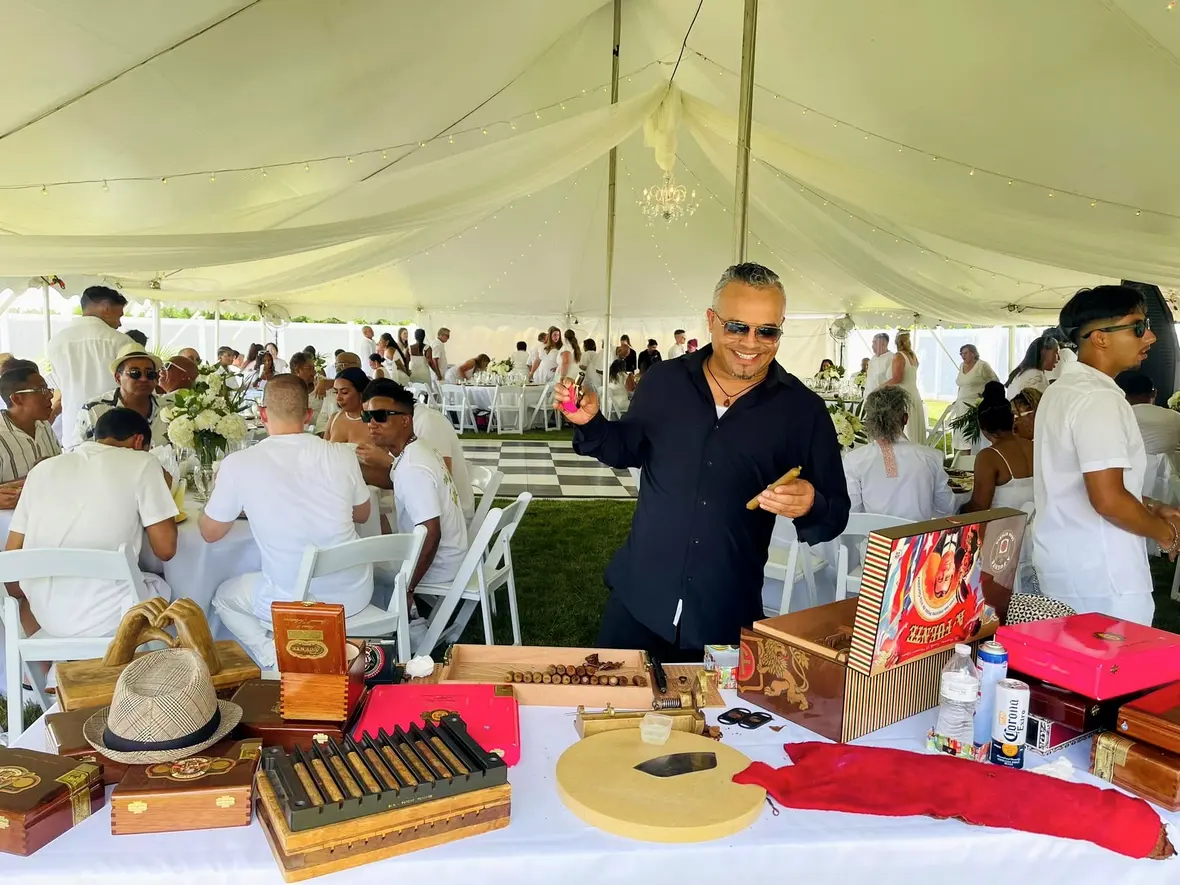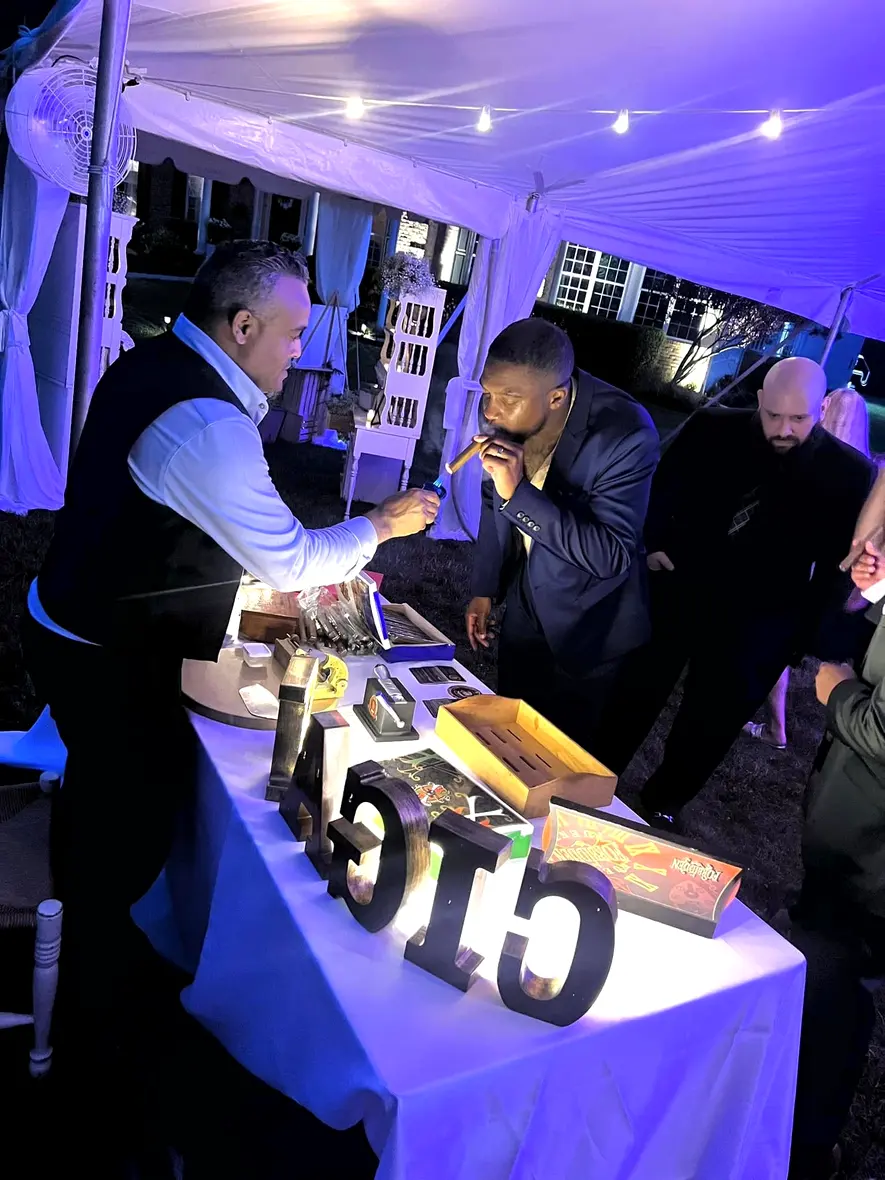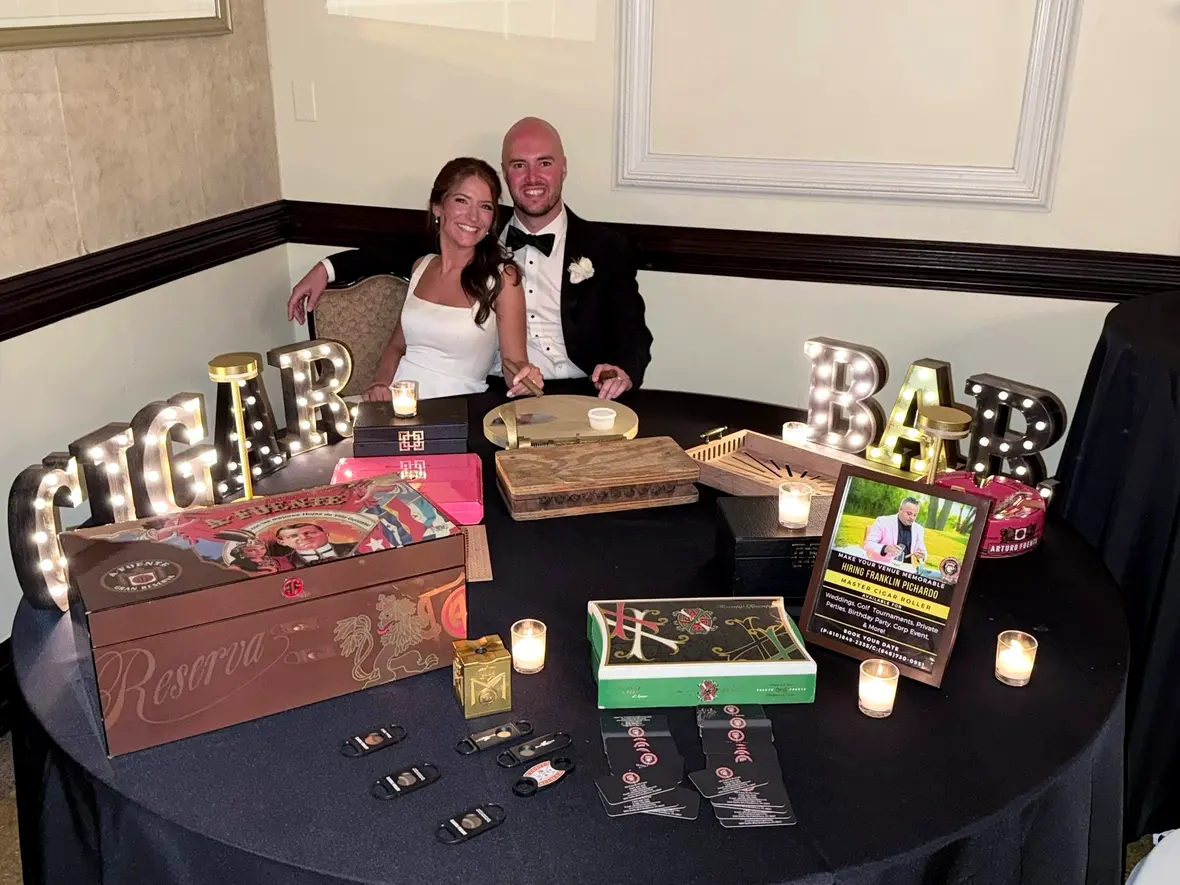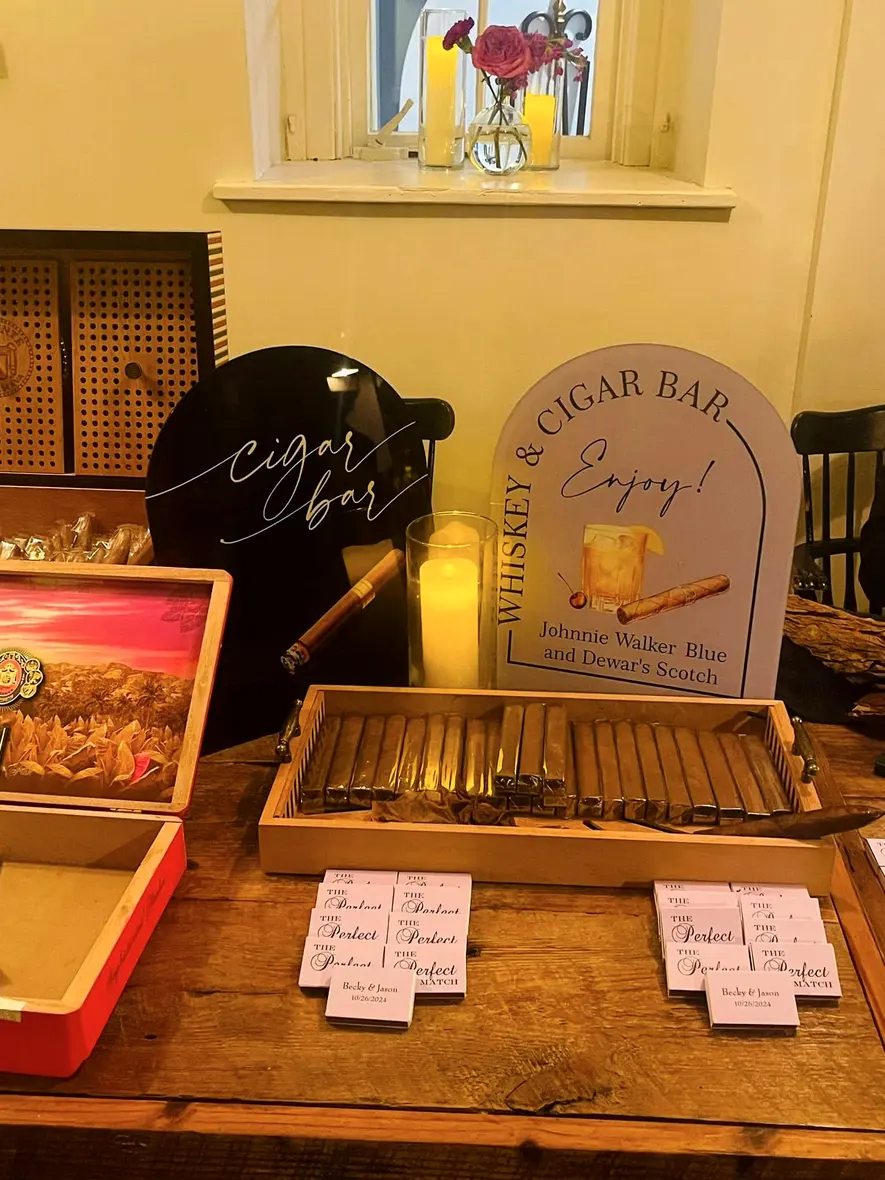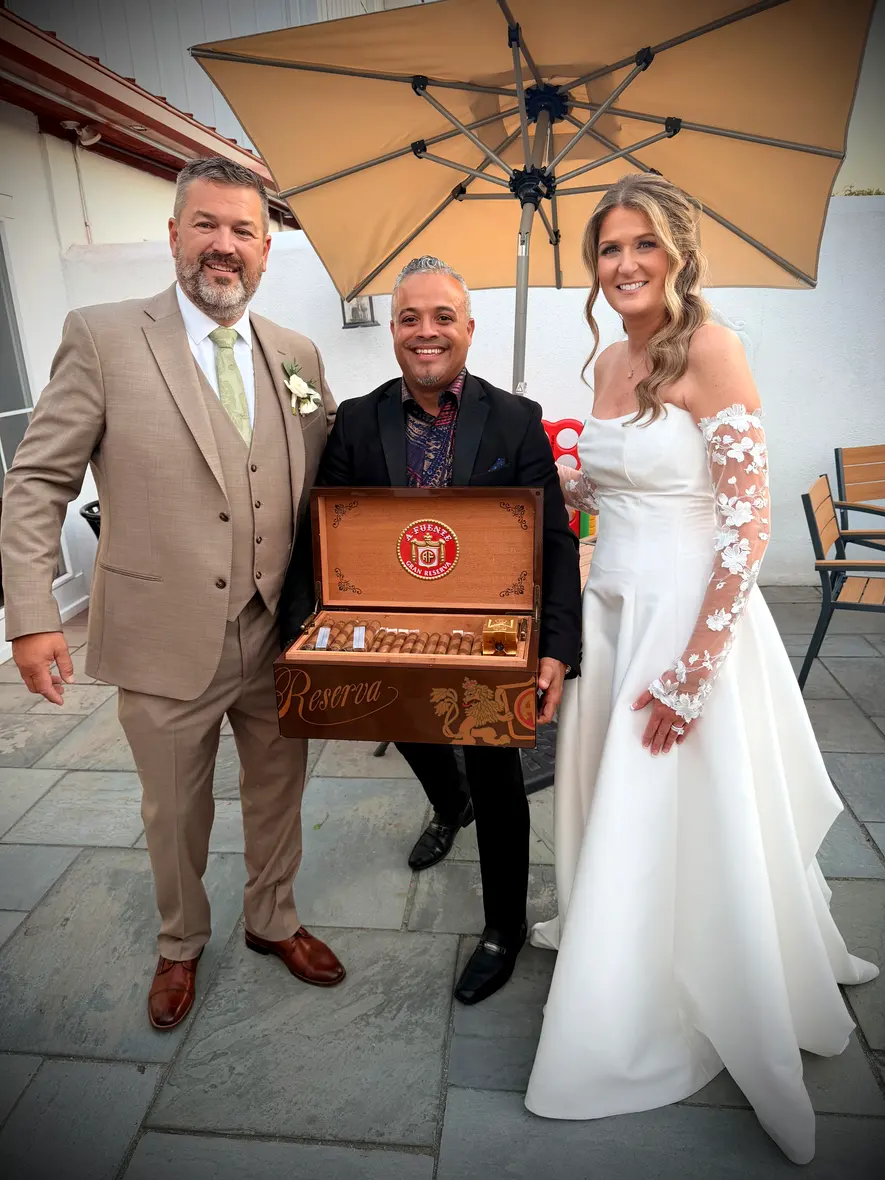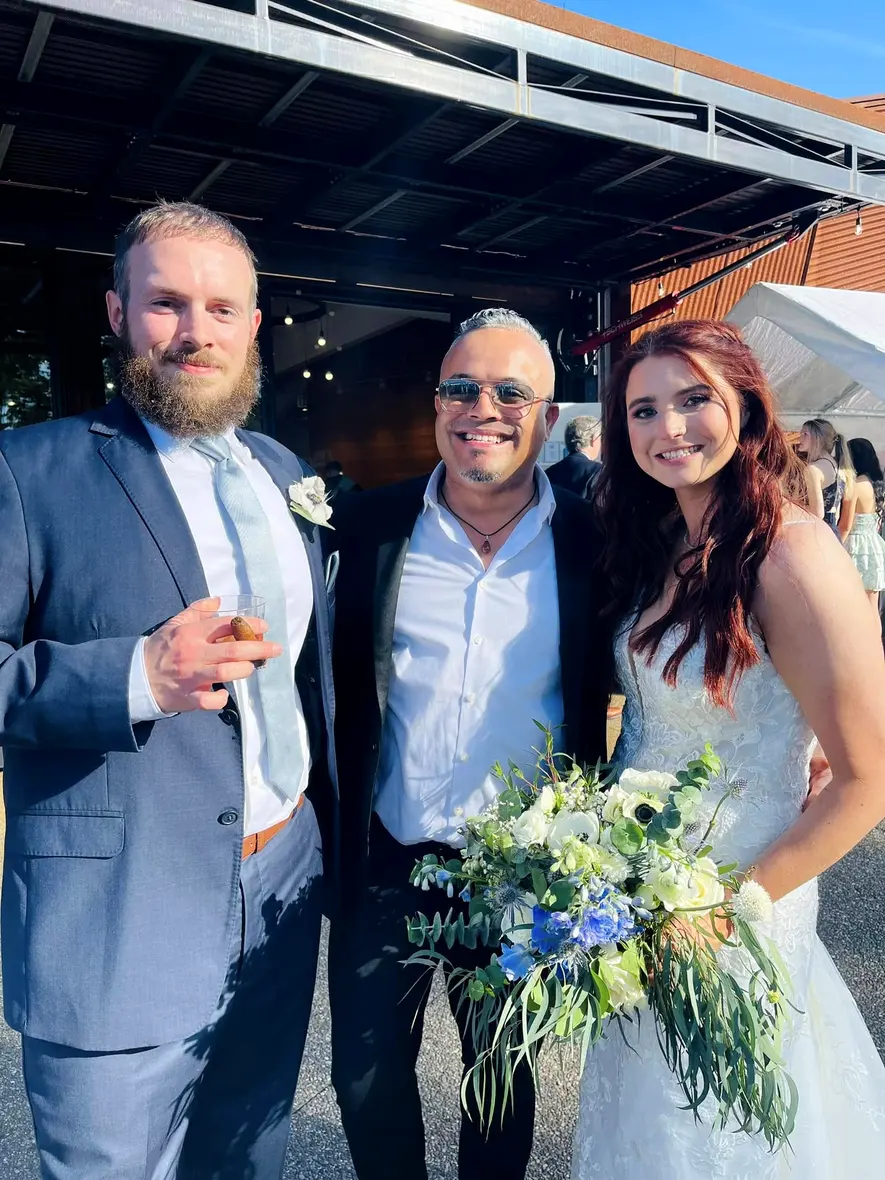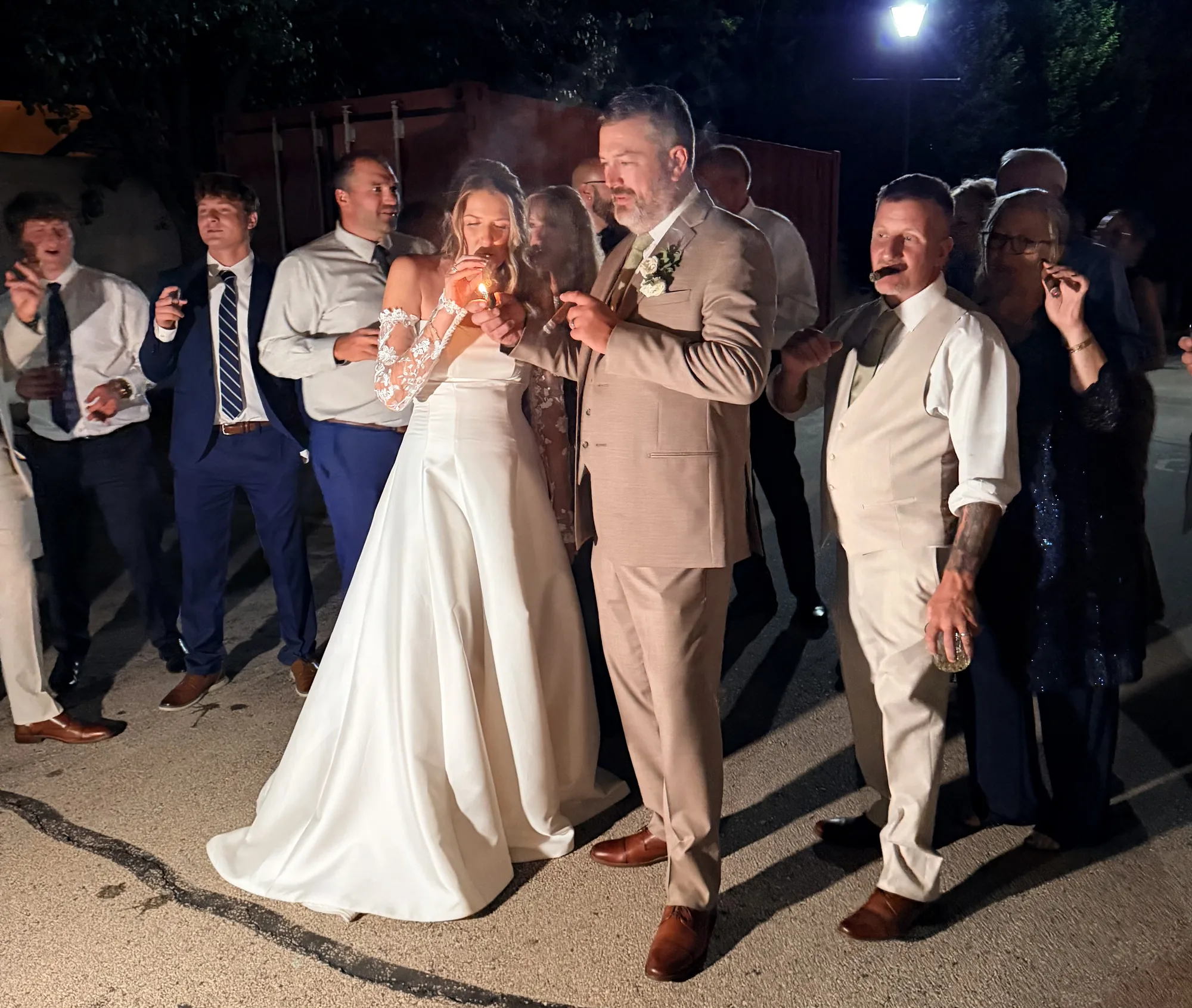
At some point in the evening, a wedding finds its second room. Sometimes it’s the bar, sometimes the porch. When there’s a cigar roller working, it is almost always the table where he sits — a chaveta, a stack of leaf, and a small crowd that wasn’t there ten minutes ago.
This guide is for the person planning that table: usually one half of the couple, sometimes a parent, often a planner who has to get it past the venue. It covers what a wedding cigar bar is, what changes when the cigars are rolled in front of your guests, where the table can go when your venue says no smoking, and when to schedule it so it adds to the night instead of competing with it.
What a cigar bar is, and what a live roller adds
A wedding cigar bar is a station where guests pick up a cigar during the reception. The simplest version is a few boxes, cutters and lighters on a table near the exit. It works, and it is mostly furniture: people take one on the way out, and the table is empty by ten.
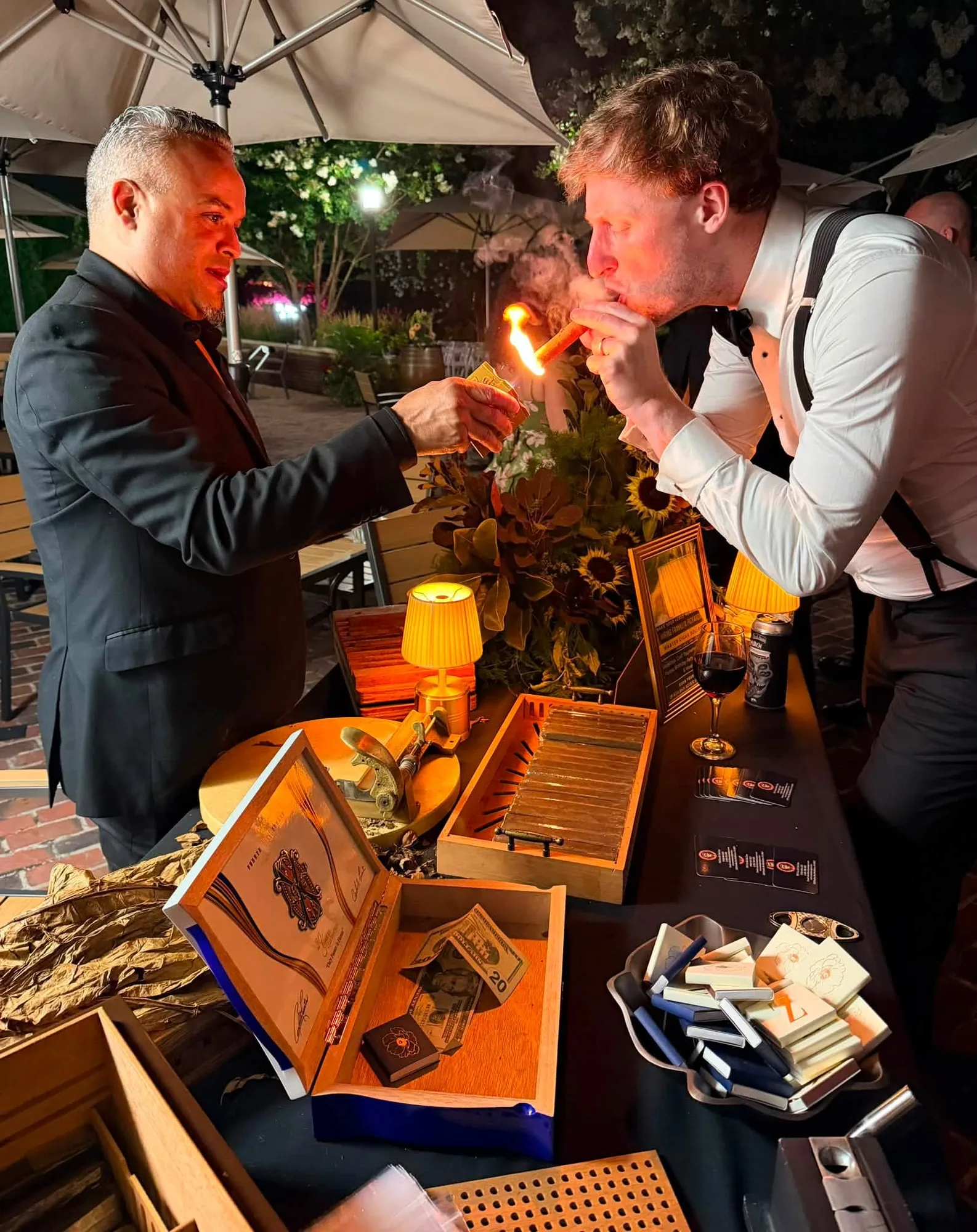
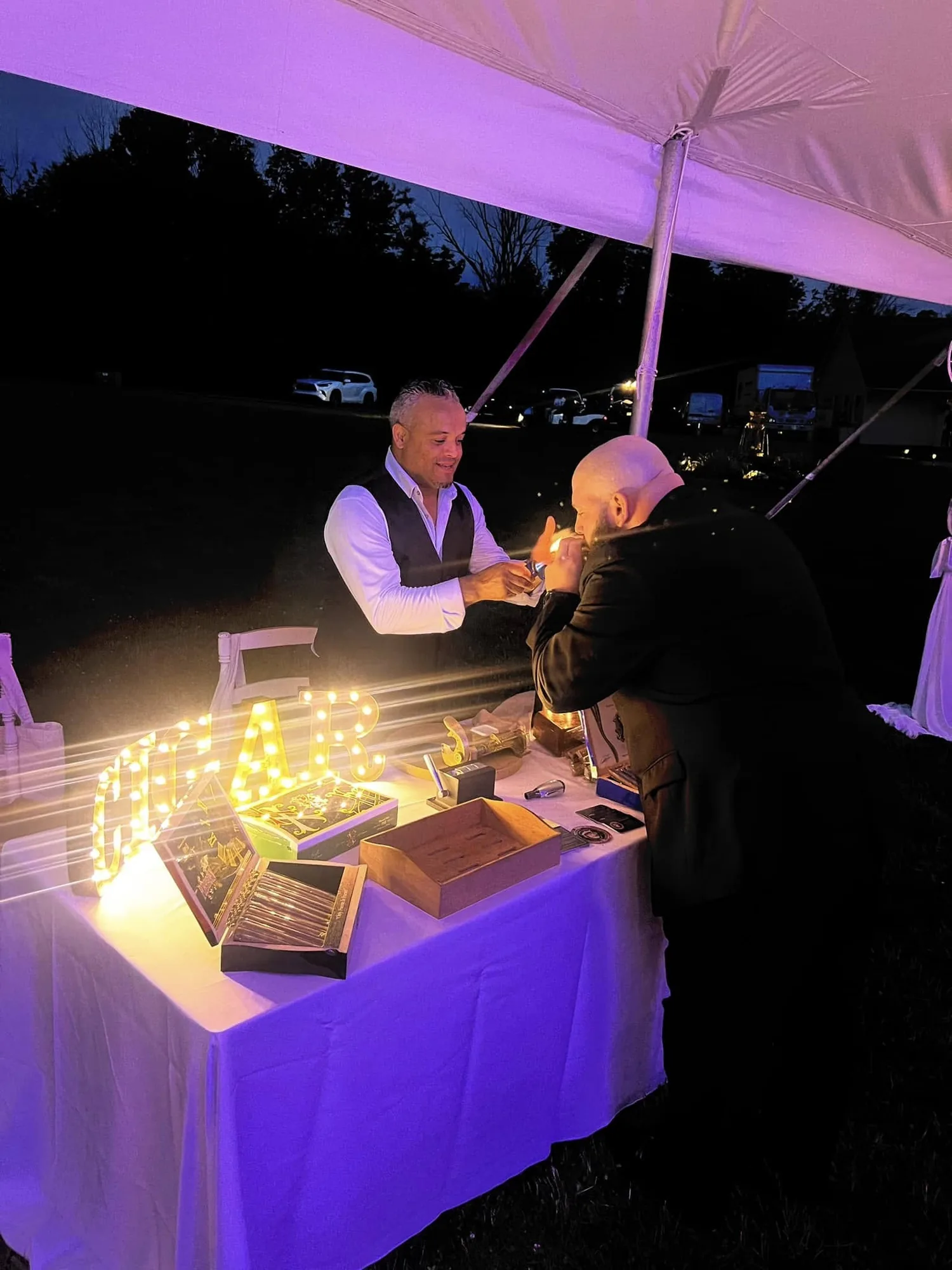
A live roller turns the same table into something guests watch. Each cigar is made in front of the person who will smoke it — the binder laid out, the filler bunched by hand, the wrapper leaf trimmed with the chaveta and rolled on. One guest stops to watch, waves a friend over, and it builds from there without anyone organizing it.
That is the difference worth paying attention to. A box of cigars is a favor. A cigar made in front of you, by hand, with your hosts’ names on the band, is a moment people describe afterward.
In Franklin’s own words, after a wedding under a tent in New Jersey: “I had the privilege of sitting down and carefully crafting hand-made cigars with unwavering passion, dedication, and love for each person who approached me.”
Where it goes: indoors, outdoors and the venue question
The first question a couple asks is rarely about the cigars. It is whether the venue will allow it.
If your venue doesn’t allow smoking
Almost no venue allows smoking indoors, and that rarely ends the conversation. A terrace, a courtyard, a tent or a lawn is where guests light up — and by that hour of the evening, that is where your guests want to be anyway.
Where the table itself stands is a separate question, and it is worth asking your venue coordinator in exactly that form. Not “can we have cigars?” but “where can the table stand, and where can guests step out to light one?” The two answers are often different. The table has stood inside a ballroom in New York, under tents in New Jersey and in a walled courtyard in Pennsylvania.

If it rains
A tent or a covered terrace is enough; the table needs cover, not sun. Most venues already have somewhere in mind, and it usually takes one phone call to settle. Make that call when the date is booked, not on the morning of the wedding.
When to schedule it, so the dance floor stays full
The worry planners raise most is that a cigar bar empties the dance floor. It is a fair worry, and the answer is timing rather than giving up on the idea. The table works to the hour you give it, and there are three good places to put it.
Cocktail hour. The table is set before the first guest walks in. It gives people who have never met something to stand around, and it fills the gap while photos are being taken.
After dinner. Speeches are done and half the room wants air. The table is where they find it, and where a line starts to form.
The last hour. The guests still there at the end are the ones who will talk about it on Monday — and the dance floor has done its work by then.
What all three have in common is that the table runs alongside the reception rather than replacing it. Guests drift over, watch a cigar get made, take theirs and go back to the party. He arrives well before your first guest, works without stopping, and packs up after the last cigar; how long he stays is simply how long you book him for.
How many cigars, and the guests who don’t smoke
One per guest is how the trade sizes a night, and it is how Franklin sizes yours. The guest count settles the hours; nothing else about the evening moves.
As for the guests who never light one: they stay at the table anyway, and most take one home for somebody. Watching a cigar get made is the part people describe afterward, to everyone who missed it. That is also why the table is worth placing where people walk past it, not tucked behind the venue.
The band with your names on it
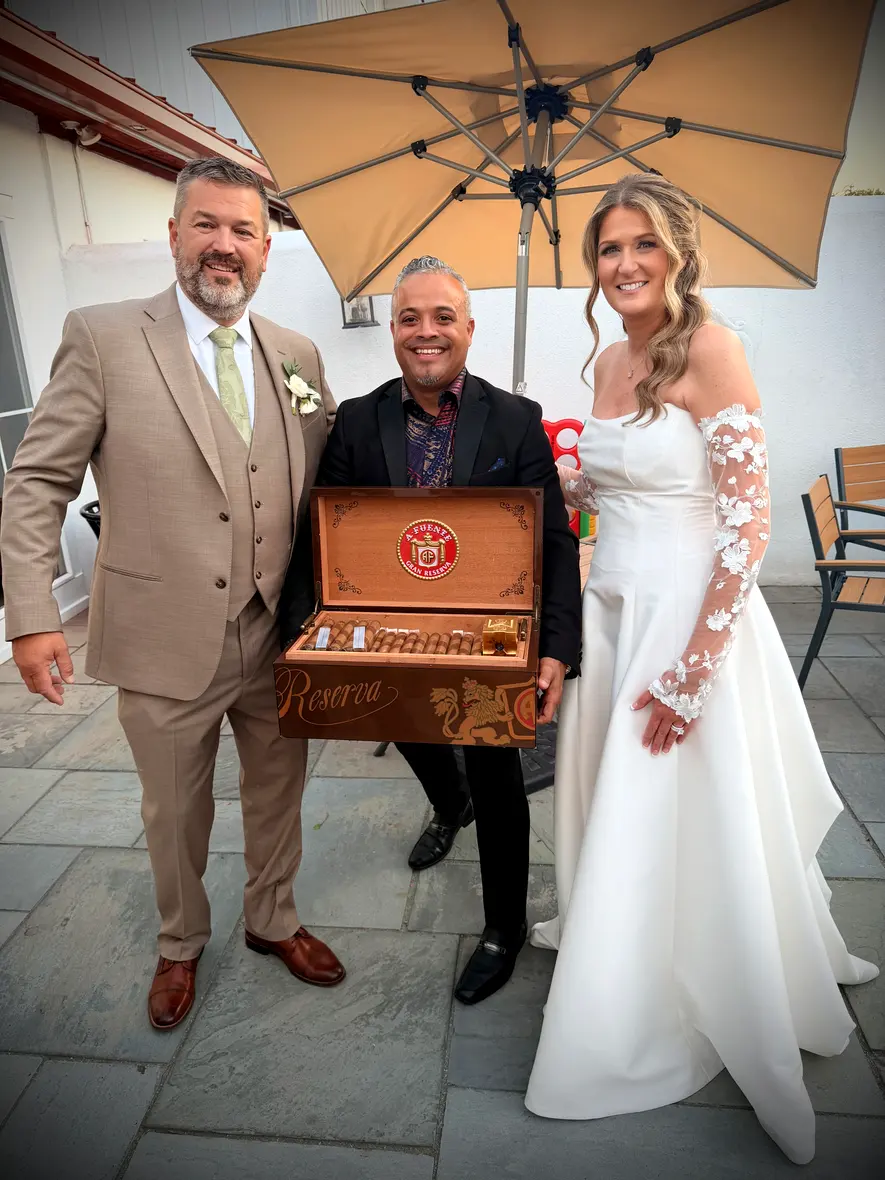
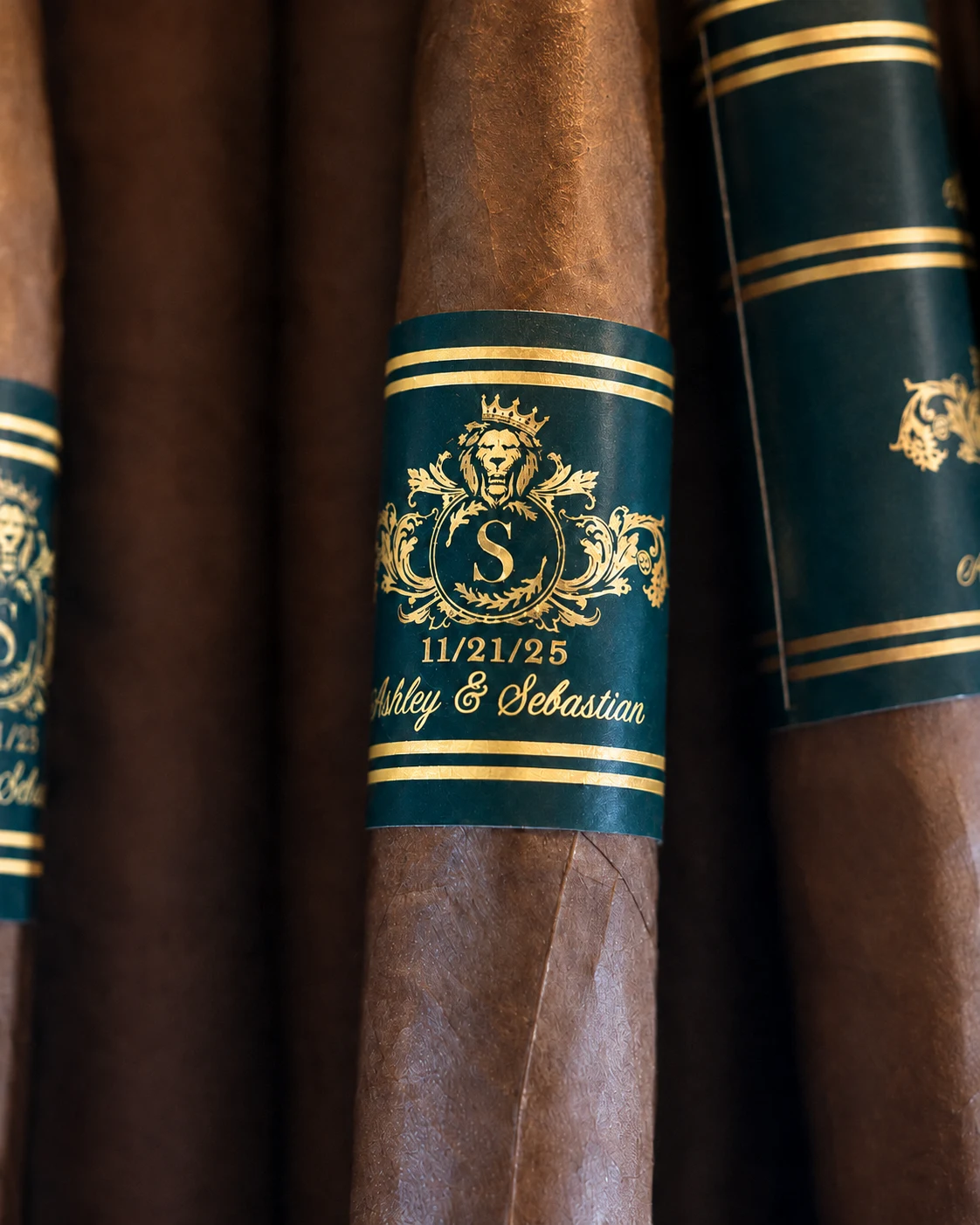
Because each cigar is rolled in front of your guest, the band you choose is the only one it will ever wear. Two names and a date, or a monogram. It is the last thing a guest reads before they light it, and the first thing they see when they find it in a jacket pocket three weeks later.
Favors get left on the table with the empty glasses. A cigar goes into an inside pocket and gets smoked months later, on somebody’s porch, with your names still on it.
Bands need enough time to be printed. The timing is settled when you book, along with the date.
What to settle before the day
Most of what makes the table work is decided weeks ahead, in a handful of answers:
- The date. It comes first, because nothing else can be held without it.
- The guest count. It decides how many cigars he brings and how many hours he stays.
- Where the table stands, and where guests smoke. Two questions for your venue, not one.
- Cover, if it is outdoors. A tent, a porch or a covered terrace.
- What the band says. Two names and a date, or a monogram, in time to be printed.
Everything else is his to bring.
Who is behind the table
A cigar bar is only as good as the person running it, so it is fair to ask who that will be.
Franklin Pichardo entered the Arturo Fuente factory in Santiago, in the Dominican Republic, in 1995 — the year the first Fuente Fuente Opus X was made. He spent fifteen years rolling a single shape, the Opus X Perfecxion No. 2, and is one of roughly twenty-eight rollers in the world cleared to make the Opus X. Cigar Journal published his story in 2016. In 2026 he was the official cigar roller of the Formula 1 Miami Grand Prix, representing Arturo Fuente alongside Carlos Fuente III.
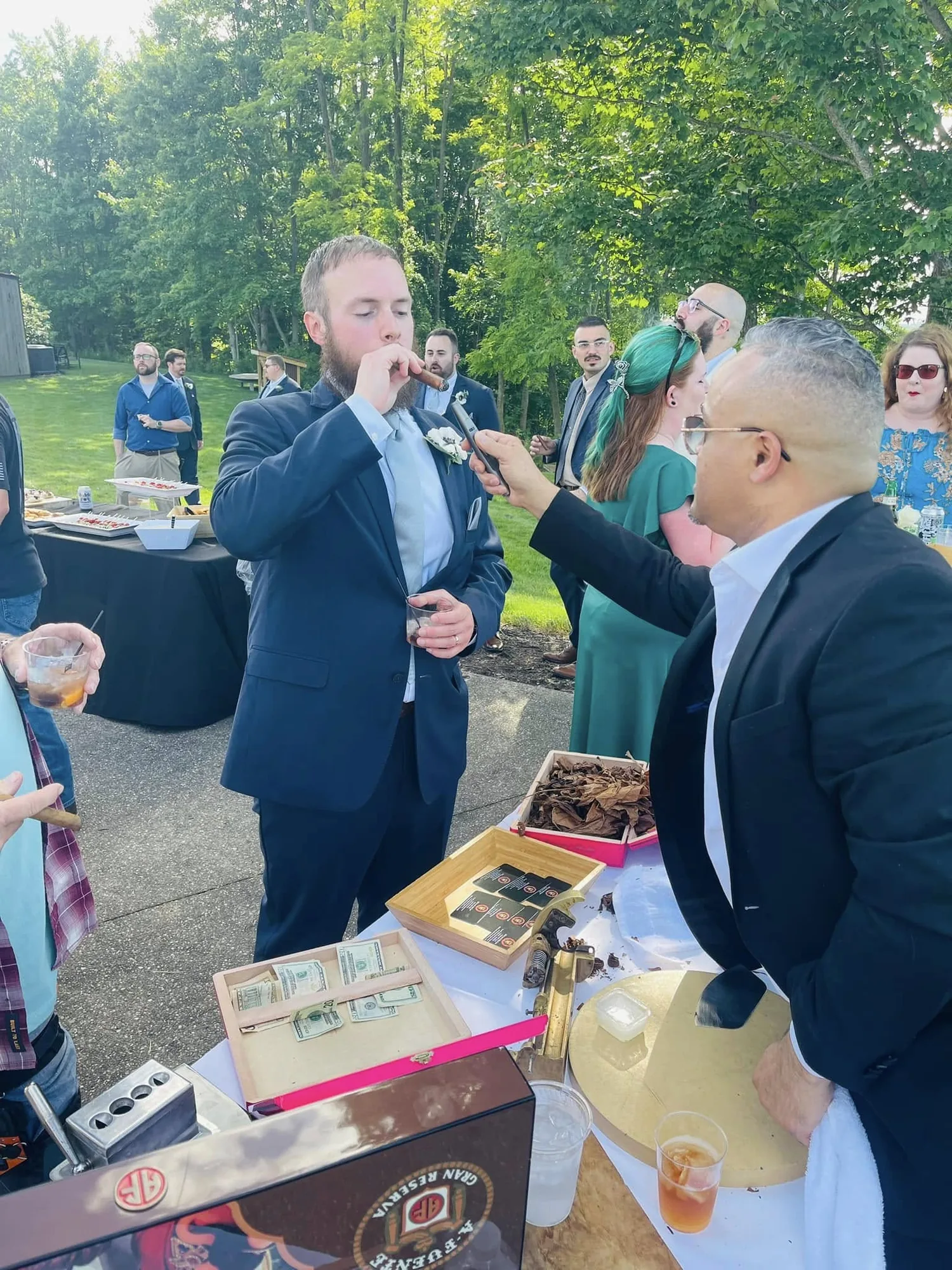
And he has rolled at weddings from a barn outside Boston to an outdoor reception in Beckley, West Virginia, to a banquet hall in Portland — under tents in New Jersey, in a New York ballroom, in a walled courtyard in Blue Bell, Pennsylvania. Every one of them is in the events archive, with the month it happened.
Booking it
Weddings get booked before anything else in the calendar, so the first step is the date. A deposit holds it, and the date leaves his calendar the moment it clears.
Everything else — your guest count, the hours, where the table goes and what the band says — is settled in one place, when you book the date. If you are still deciding, the weddings page shows the table at work, and the archive has every wedding he has rolled, with the month and the place.